

History of 3D Projection Mapping
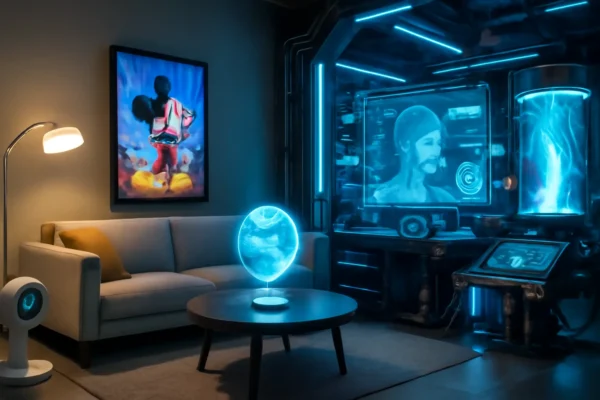
3D projection mapping is the technique of projecting video onto real objects and shaped surfaces, like a sculpture, a cake or the front of a building, so the image fits every edge. Its history runs from 1950s stage experiments and the singing busts of Disneyland’s Haunted Mansion in 1969, through art and university research in the 1980s and 1990s, to the building shows and event installs you see today.
Below you will find a clear timeline, the people who shaped the craft, and how projection mapping is used at weddings, Bar and Bat Mitzvahs and corporate events in Los Angeles right now.
Projection Mapping Timeline: Key Dates
| Year | Milestone | Why it matters |
|---|---|---|
| 1958 | Laterna Magika premieres at the Brussels World’s Fair (Expo 58) | Projected film works together with live performers and stage pieces |
| 1969 | Disneyland’s Haunted Mansion opens with Madame Leota and the singing busts | Filmed faces projected onto sculpted heads, often cited as the first public projection onto shaped objects |
| 1980 | Michael Naimark creates Displacements | A whole furnished room becomes the projection surface |
| 1991 | Disney patent for projecting images onto three dimensional objects | The technique moves into engineering and industry |
| 1998 | UNC Chapel Hill publishes the Office of the Future research (Raskar, Welch, Fuchs and team) | Introduces the idea of spatially augmented reality |
| 1999 | John Underkoffler’s I/O Bulb at the MIT Media Lab | A projector paired with a camera, so projections can respond to people and objects |
| 2001 | Shader Lamps (Raskar, Welch, Low, Bandyopadhyay) | Plain white objects “painted” with light using calibrated projectors |
| 2005 | Oliver Bimber and Ramesh Raskar publish the book Spatial Augmented Reality | Brings the research together for a wider audience |
| 2010s to today | Brighter laser projectors and media servers such as Resolume, MadMapper and Disguise | Building shows, concerts, brand activations and private events become practical |
Ghosts in the Parlor: Haunted Mansion, Theme Parks & Early Spectacle
The roots of the history of projection mapping stretch back much further than the digital age. Today artists, brands and event companies use 3D projection mapping to create huge displays, but the origin story most people point to begins in a place of fantasy and illusion: Disneyland’s Haunted Mansion.
Projection mapping history: Disneyland, 1969
In 1969, the Haunted Mansion opened its doors, and with it came a new kind of visual trick. It is widely cited as the first known public display of projection mapping on complex surfaces. Disney’s Imagineers projected moving images onto three dimensional busts, not just flat screens. This was the moment projection mapping on complex surfaces went from theory to something families could ride through.
How the Haunted Mansion busts came to life
Behind the scenes, it was clever engineering plus movie making know how. The famous Madame Leota scene features a crystal ball with a face floating inside. The Imagineers filmed an actress’s face on 16mm film, then projected that footage onto a sculpted head inside the crystal ball. The result is a ghostly talking head that seems to defy physics.
The same idea brought the Grim Grinning Ghosts to life. This chorus of singing busts uses filmed performances projected onto sculpted heads, in sync with the ride’s soundtrack.
Before Disney: Laterna Magika, 1958
Theater makers were already blending projected film with real stage pieces. Laterna Magika, which premiered at the 1958 Brussels World’s Fair, combined film projection with live performers and moving screens. It was not mapping in today’s sense, but it showed audiences that projected images and physical objects could work as one show.
Why the Haunted Mansion mattered
It is easy to overlook how new this was. Back then, putting moving images onto a sculpted surface was almost unheard of outside experimental theater. Yet here it was, thrilling families at a theme park. These were not just special effects. They were the seed for a whole genre of illusion, long before “augmented reality” became a common phrase.
From film reels to a new craft
The projection mapping Haunted Mansion milestone did more than entertain. It showed what was possible when storytelling and technology work together. The use of 16mm film projection on sculpted busts marked a turning point in the history of projection mappingand later art installations and interactive displays all trace a line back to these early experiments.
Timeline and evolution of projection mapping
Looking back, these illusions were more than theme park tricks. They were early blueprints for later projection mapping milestonesmoments when technology and imagination met to create something new. It started with a few ghosts, a handful of film reels and a bold idea of what light could do.
Living Rooms, Labs & Patents: From Naimark’s Rotating Rooms to Disney’s Digital Ambitions
The story of projection mapping is not just about big visuals at concerts or on city buildings. It is also a story of art experiments, patents and university research that shaped what we now call spatial augmented reality.
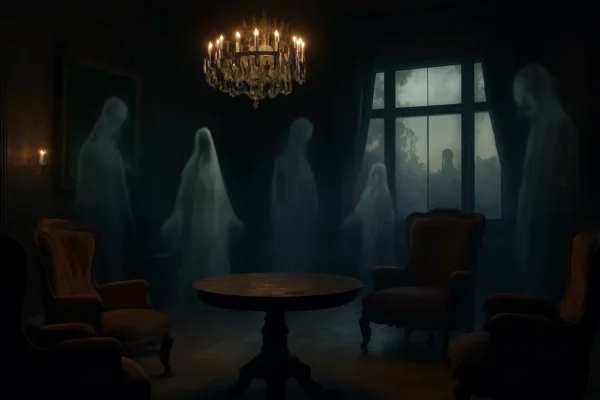
One of the most striking early milestones was the Michael Naimark Displacements installation in 1980. Naimark filmed a furnished living room with performers, using a camera that slowly rotated in the center of the room. Then he painted the room and everything in it white and put a projector in the camera’s place, turning the same way. The film landed back on the objects it came from, so the room itself became the screen.
Why Displacements mattered
This was a leap in immersive storytelling. Naimark showed that projection mapping could transform real, complex spaces, not just flat screens or simple shapes.
The 1990s then moved the idea into industry. Disney’s 1991 projection mapping patent described a system for projecting images onto contoured, three dimensional objects. It was a clear sign that companies saw real potential in the technique, and it helped move projection from bedsheets to sculptures and building facades.
Projection mapping early pioneers
General Electric followed with its own patent in 1994, another sign that the tech world was taking projection onto objects seriously.
Then came a jump in academia. In 1998, a team at UNC Chapel Hill that included Ramesh Raskar, Greg Welch and Henry Fuchs published The Office of the Future. Their idea: projectors that could show life size remote collaborators and virtual objects on any wall, desk or surface. The same group described this approach as spatially augmented realityand today the field is usually called spatial augmented reality. Their system also captured the shape of the room with cameras and projected light patterns, an early cousin of later depth sensors.
From labs to the real world
Artists like Naimark, engineers at Disney and GE, and researchers at UNC moved projection mapping from haunted mansions and living rooms into patents and research labs. Each step gave the technique a stronger base in theory and practice. The result is a craft that is as much about imagination as it is about engineering.
-
1980: Michael Naimark’s ‘Displacements’ installation redefines immersive projection
-
1991: Disney projection mapping patent
-
1994: General Electric follows with its own patent
-
1998: UNC Chapel Hill’s ‘Office of the Future’ introduces spatially augmented reality
When Objects Come Alive: Shader Lamps, Smart Bulbs & Creative Chaos
By the early 2000s, projecting onto 3D surfaces like drapes, tabletops and objects was no longer only a lab challenge. It was becoming a playground for artists and engineers.
The Shader Lamps project in 2001, by Ramesh Raskar, Greg Welch, Kok Lim Low and Deepak Bandyopadhyay, stands out as a turning point. Using cameras, projectors and software, plain white objects could be “painted” with light, so a model looked like it had color, texture and shading that were never really there. Think of a white vase that suddenly looks like painted ceramic. It was a big step in technological advancements in projection mapping.
Projection mapping interactive experiences
The seeds were planted a bit earlier. In 1999, John Underkoffler introduced the I/O Bulb at the MIT Media Lab. It combined a projector and a camera in one unit, laying the groundwork for interactive projection mapping concepts. His idea was bold: any lamp in a room could become a smart projector that sees and responds to what is on the table. That idea lives on in today’s interactive floors and wallswhich react when guests step or wave.
Evolution of 3D projection mapping
In the mid 2000s, Oliver Bimber and Ramesh Raskar pushed further, exploring handheld projectors and ways to project onto curtains, paintings and desktops. In 2005 they published the book Spatial Augmented Realitywhich pulled the research together. Projection was no longer limited to flat walls. It could wrap around the folds of a curtain or the curves of a sculpture.
From research demos to everyday shows
These experiments turned static rooms and objects into living images. Today projection mapping on complex surfaces is central to immersive experiences in events, marketing and entertainment, and the playful spirit of the first Shader Lamps demos lives on in every interactive light show.
Looking back, the early 2000s were a time of fast progress. Better projection mapping technologysmarter cameras and a willingness to experiment turned ordinary objects into canvases for storytelling. The core idea is still the same: with the right tools, almost anything around us can come alive with light.
If These Walls Could Talk: The Future Is Still Unwritten
Looking at the long history of 3D projection mappingit is easy to imagine a future where living room walls tell new stories every night. Given how far projection mapping immersive experiences have come, the idea is not far fetched. The path from Haunted Mansion illusions to today’s interactive projection has always been about pushing technical and creative limits.
Projection mapping on complex surfaces
The field is still experimental. Some of the best ideas in projection mapping art installations start as sketches on napkins or late night brainstorms. Each new advance, whether a better way to map curved surfaces or a clever use of spatial augmented reality, opens the door to more experiments.
Projection mapping software and community
Community plays a big role. Forums and resources like Projection Mapping Central bring tinkerers, artists and technologists together, and shared tutorials have made mapping software far easier to learn. The future of projection mapping applications is being shaped by big companies and labs, and also by a global network of people who share what works.
As the technology gets easier to use, new questions come up about privacy and how much of our world should become a screen. Those debates are far from settled, and they add another layer to the future of interactive projection mapping concepts.
Whether you are dreaming up the next big art installation or projecting a crown onto the family dog, the walls around us are waiting for new stories.
Projection mapping milestones still to come
The future of projection mapping remains open to experimenters, dreamers and anyone willing to see the world as a canvas. The next chapter could start with a spark of inspiration, a playful experiment or a community project.
How Projection Mapping Is Used at Events Today
The same ideas that made the Haunted Mansion busts sing now show up at private parties and corporate events every weekend. Here is how we see it used across Los Angeles, Orange, San Diego and Ventura counties:
- Weddings: monograms and florals projected on ballroom walls, a mapped wedding cake, or a short story of the couple played during the grand entrance.
- Bar and Bat Mitzvahs: a themed room that changes with each part of the night, name and logo animations, and mapped intro videos before the first dance set.
- Corporate events and product launches: logos and product reveals mapped onto stage sets, sculptures or the product itself.
- Brand activations: mapped storefronts, pop up walls and interactive floors that react when guests step on them.
- Holiday house displays: Christmas and Halloween shows mapped onto the front of a home. If you want to try one yourself, see our Christmas house projection mapping DIY guide.
What a modern projection mapping setup needs
Today’s shows run on media servers and mapping software such as Resolume, MadMapper or Disguise. These tools warp and mask the video so it fits each surface and edge.
Brightness is measured in lumens. A dimmed ballroom can work with a single bright projector, while a large outdoor facade needs much more light, often from several projectors blended together. Throw ratio tells you how far back a projector must sit for a given image width. A throw ratio of 1.5 means about 15 feet of distance for a 10 foot wide image.
| Event type | Common surfaces | Planning notes |
|---|---|---|
| Wedding | Ballroom walls, cake, dance floor | Indoors with lights dimmed; check venue rigging rules |
| Bar or Bat Mitzvah | Walls, stage, dance floor | Time content to the entrance and candle lighting |
| Corporate event | Stage set, product, sculpture | Allow time for brand approvals and a full rehearsal |
| Brand activation | Storefront, booth, floor | Often interactive; may run for several days |
| Holiday house | Home facade | Outdoors; needs dark hours, weather protection and more lumens |
For a full walkthrough of gear, process and planning, read our projection mapping guide. If you only need a projector for slides or video, our projector and screen rentals cover that. For bright rooms or daytime events, an LED screen rental is often the better choice, and larger shows can be handled by our event production team.
Frequently Asked Questions
When was projection mapping invented?
There is no single invention date. Theater makers combined projected film with stage pieces in the 1950s, such as Laterna Magika in 1958, and Disneyland’s Haunted Mansion projected filmed faces onto sculpted busts in 1969. The academic name, spatial augmented reality, grew out of research at UNC Chapel Hill between about 1998 and 2001.
What is the difference between projection mapping and regular projection?
Regular projection puts a rectangle of video on a flat screen. Projection mapping warps and masks the video so it fits a real object or surface, and light only lands where you want it.
Who were the pioneers of projection mapping?
Key names include Disney’s Imagineers (Haunted Mansion, 1969), artist Michael Naimark (Displacements, 1980), Ramesh Raskar, Greg Welch and Henry Fuchs at UNC Chapel Hill, John Underkoffler at the MIT Media Lab, and Oliver Bimber.
What software is used for projection mapping today?
Popular tools include Resolume Arena, MadMapper and HeavyM for small and mid size shows, and Disguise media servers for large concerts and installations. The right choice depends on the number of projectors and how complex the surface is.
Can projection mapping work at a wedding or Bar Mitzvah?
Yes. Ballrooms work well because the lights can be dimmed. Walls, cakes, dance floors and backdrops are all common surfaces. Plan for a site visit and a test before the event.
How much does projection mapping cost in Los Angeles?
It depends on the size of the surface, the number of projectors, the custom content and how long the show runs. We price each project after reviewing the venue, so the best first step is to request a quote.
Plan Your Projection Mapping Show
Angels Music Productions has provided DJ, AV and projection mapping for more than 1,000 events since 2015, working from our office in Valley Village. If you want to see what mapping can do for your wedding, Bar or Bat Mitzvah, corporate event or holiday display, explore our projection mapping servicesrequest a quoteor call us at 949-394-2572.


